

A Fiancé Visa is a special visa for fiancés of U.S. citizens to come to the United States for the purpose of getting married in the United States to the U.S. citizen petitioner. The marriage must take place within 90 days of the Fiancé’s arrival in the country. The popular reality tv series, “90 Day Fiancé”, highlights the romantic drama of this particular visa process.
Please note that we are using the common use of the noun, fiancé, to refer to all engaged individuals regardless of sex or gender, though we realize that the proper use of the noun is gender specific.
Navigate through the sections below to gain a comprehensive understanding of the Fiancé Visa and Green Card processes, which will equip you with the knowledge to make informed decisions on your journey toward building a life together in the United States.
How Does the Fiancé Visa Work?
When a United States citizen wants to bring their fiancé to the United States, they can submit a I-129F Fiancé Petition. This is the first step in the Fiancé Visa Process.
The I-129F Petition establishes the underlying relationship for the Fiancé Visa Application (Form DS-160). Once the I-129F Application is approved, the fiancé can apply for the Fiancé Visa using Form DS-160 through the U.S. Department of State. The Fiancé Visa they will receive is called a K-1 Visa. The K-1 Visa is used to come to the United States and marry the United States citizen petitioner.
To be eligible for a fiancé visa, the couple must have met in person within the last two years (unless they qualify for limited exceptions to this requirement) and they must intend to marry in the United State within 90 days of the fiancé’s entry on the K-1 Visa. The fiancé must not have any criminal or immigration related offenses in their past that make them inadmissible to the United States unless they qualify for an immigration waiver.
A fiancé may qualify for a waiver to overcome certain inadmissibility offenses for the K-1 Visa if they would otherwise qualify for a general waiver for the specific offense if they were married to the U.S. citizen petitioner.
If a fiancé gets an immigration waiver approved, it is conditioned on their marriage to the U.S. citizen petitioner once the fiancé arrives in the United States. If that act does not occur, the waiver is no longer valid.
When the fiancé comes to the United States and marries the United States citizen petitioner within 90 days of their arrival, the fiancé visa process is complete. To remain in the United States, the fiancé (now spouse of a U.S. citizen) will need to apply for adjustment of status to become a Lawful Permanent Resident of the United States (Green Card Holder).
Fiancé Visa vs. Marriage Green Card
The process for a fiancé of a United States citizen and a spouse of a United States citizen are different similar but different. For a spouse of a United States citizen, there are two ways to obtain a Green Card based on their marriage based on where the foreign national spouse currently resides.
If the foreign national spouse is applying for a Green Card from within the United States, they generally can apply through a process called adjustment of status. This involves submitting an I-130 Spousal Petition and I-485 Green Card Application together from within the United States where they will attend an interview at USCIS to get the green card approved.

If the foreign national spouse is applying for a Green Card from outside of the United States, they will go through a process called consular processing. This involves submitting an I-130 Spousal Petition first and then a DS-260 Immigrant Visa Application after the I-130 Spousal Petition is approved. The spouse will attend an interview at a U.S. Consulate abroad in order to obtain the Spouse Visa (IR1) to come to the United States. After their arrival in the United States, the Green Card will be mailed to them at their U.S. address.
The Fiancé Visa process is basically a combination of these two marriage-based green card processes. The fiancé must go through Consular Processing to obtain the Fiancé Visa (K1 Visa) and they will also need to go through the process of adjusting their status to that of a Lawful Permanent Resident (Green Card Holder) after they arrive in the United States and marry the U.S. citizen petitioner.
The fiancé visa process is limited in that it only establishes the act of getting the fiancé to the United States. It does not result in a green card in the same way as the spousal visa application process (IR1 Visa). In order to stay in the United States, the fiancé must go through the additional process of applying for a green card based on their marriage to the I-129F Petitioner (their now U.S. citizen spouse).
At that point, the process for the fiancé to obtain a green card is not much different than spouses of U.S. citizens applying for a green card from within the United States. The only difference is the underlying petition (I-129F Fiancé Petition instead of an I-130 Spousal Petition) and that the rule that the fiancé is only eligible for a green card in the United States when they marry the I-129F Petitioner.
If the fiancé got to the United States and fell in love with another U.S. citizen for example, they could not apply for a Green Card in the United States based on this new marriage to another U.S. citizen. In this way, a fiancé’s eligibility for the green card is limited in contrast to other marriage green card applicants in the United States.
In summary, the fiancé visa process requires the additional step of applying for a green card in the United States. This additional step is similar to green card application for spouses of United States citizens who did not come to the United States as a fiancé. When spouses of U.S. citizens come to the United States with a Spouse visa, this additional step is not required as they will receive their green card upon their arrival to the United States unlike fiancés who must marry the U.S. citizen petitioner to become eligible for a green card.
There is an additional matter to consider and that is the conditional residency rule. In immigration, spouses of U.S. citizens who have not been married for a period of at least two years when their green card is approved will only receive a conditional green card. In order to remove the conditions, the spouse must apply for the removal of conditions through Form I-751 with USCIS before the expiration of their conditional green card. This rule will often apply to fiancés since they are applying for a green card soon after their marriage in order to remain in the United States.
Which is Faster, a Fiancé Visa or Spouse Visa?
In terms of getting the Fiancé or Spouse to the United States, there is not much difference in timing between the two processes. One is not necessarily faster than the other. They both take approximately the same amount of time because the processing times for the I-129F Fiancé Petition and I-130 Spousal Petition are much the same. After the approval of the underlying petition, the two go through the same type of consular processing to obtain the visa.

However, the fiancé process involves the additional step of applying for a green card after the marriage takes place in the United States. For this reason, the fiancé visa path to obtain a green card takes longer than the spousal visa process. To better understand how these processes all compare, it is easiest to take a look at the timeline for each individual process up to the point of obtaining a green card.
Timeline Comparison of Fiancé Visa, Spouse Visa, and Marriage Green Card based on relationship to United States Citizen Petitioner (Based on Current USCIS Processing Times):
Timeline for Fiancé Visa to Green Card
- Step 1: I-129F USCIS Processing – 3.5 to 22 months
- Step 2: Fiancé Visa Application (DS-160) Processing and Interview – 4 to 6 months
- Step 3: Arrival in the United States and Marriage
- Step 4: I-485 Green Card Processing – 30.5 months (for Interview in Atlanta, Georgia)
Timeline for Spouse Visa to Green Card
- Step 1: I-130 USCIS Processing – 10.5 to 16 months
- Step 2: Spouse Visa Application (DS-260) Processing and Interview – 4 to 6 months
- Step 3: Arrival in the United States and Mailing of Green Card – 1 to 3 months
Timeline for Marriage Green Card Through Adjustment of Status in the United States
- Step 1: I-130 and I-485 Joint Processing – 30.5 months (for Interview in Atlanta, Georgia)
- Step 2: No further Steps – that’s it.
There will be an additional step for individuals who have not been married for two years when the green card or spousal visa is approved. These individuals will have to go through the process of removing the conditions on their conditional green card within two years of the green card approval. This is done by submitting form I-751 and supporting documents with USCIS.
Now that we know the time line for each, let’s compare the cost of the fiancé visa, spouse visa, and marriage green card through adjustment of status in the United States. The following is a breakdown of the government fees for each individual process.
Costs Associated with Fiancé Visa

Cost of Fiancé Visa to Green Card
- I-129F Petition: $535.00
- K-1 Fiancé Visa Application: $265.00
- I-458 Green Card Application: $1,225.00
Cost of Spouse Visa to Green Card
- I-130 Spousal Petition: $535.00
- Spouse Visa Application (Including I-864): $445.00
- Immigrant Fee (to mail Green Card): $220.00
Cost of Marriage Green Card Through Adjustment of Status in the United States
- I-130 Spousal Petition: $535.00
- I-485 Green Card Application: $1,225.00
The government fees can change. Please visit the USCIS and U.S. Department of State websites for the most up to date government fees for each process. The fees for U.S. Visas can be found here:
The USCIS fees can be found on the page specified for any particular form. For example, the government filing fee for the I-485 Green Card application can be found on the I-485 page here:
Now that we have compared the different processes for a fiancé and a spouse of a United States citizen, let’s take a closer look at the overall fiancé visa process.
How Do You Qualify for a Fiancé Visa?
To qualify for a Fiancé Visa, you must first get an I-129F Petition approved by USCIS which establishes that you intend on marrying the U.S. citizen petitioner within 90 days of coming to the United States, you are eligible to marry, and you have met the U.S. citizen petitioner in person within the last two years. The I-129F Petition is submitted by the United States citizen seeking to bring their fiancé to the United States.

There are limited exceptions to the rule requiring the couple to have met in person within the last two years. A couple might qualify for an exception if meeting in person is contrary to long-established customs of the fiancé’s culture or social practice and all other arrangements have been made according to custom or practice. There is an additional exception for couples who can show that the requirement to meet in person would result in extreme hardship to the petitioning U.S. citizen.
There are additional rules in place to protect vulnerable fiancés taking this big step in their lives of leaving their home country to marry the U.S. citizen in the United States. These rules require that the U.S. citizen petitioner disclose their criminal history related to certain offenses such as domestic violence, violent crimes, and three or more offenses related to a controlled substance or alcohol.
Additionally, the I-129F Petition will not be approved if the U.S. citizen petitioner has submitted two or more petitions for other fiancés in the past or less than two years have passed since the petitioner had a prior fiancé petition approved. These are considered multiple filing limitations. However, the petitioner may be able to waive these filing limitations based on particular circumstances.
Waivers for Fiancé Visa Multiple Filing Limitation
To overcome the multiple filing limitations for the fiancé visa, the U.S. citizen petitioner may request a general waiver, extraordinary circumstances waiver, or mandatory waiver depending on the circumstances.
A general waiver is for individuals who are trying to overcome the multiple filing limitation and they have never been convicted of a violent criminal offense. For the waiver application, the petitioner will want to explain the previous filings and the circumstances surrounding the termination of the relationship(s).
The extraordinary circumstances waiver is for individuals who are trying to overcome the multiple filing limitation and they have been convicted of a violent criminal offense. Extraordinary circumstances must be present for this waiver to get approved by USCIS.
Lastly, the mandatory waiver is for individuals who are trying to overcome the multiple filing limitation when they have committed a violent criminal offense within the circumstances of a domestic violence situation as the partner being subjected to battery or extreme cruelty.
If a petitioner falls under a multiple filing limitation, they must get one of these waivers approved depending on the circumstances in order to get the I-129F Fiancé Petition approved by USCIS.
Fiancé Visa (K-1) Next Steps
After the I-129F Petition is approved by USCIS, they will send it to the National Visa Center for further processing. The National Visa Center will send the approved I-129F Petition to the U.S. Consulate abroad that will be conducting the fiancé visa interview. A letter with instructions of how to complete the next step of the Fiancé Visa Application will be issued at that time.
From this point, the fiancé will need to submit the fiancé visa application (DS-160) online with the required fees. The fiancé will need to bring the following documents to their interview along with any documents requested by the specific U.S. Consulate that will be conducting the fiancé visa interview:
- A valid passport that will be good for at least six months beyond the date of intended arrival in the United States
- Birth Certificate
- Divorce or Death Certificates for both the Petitioner and Fiancé related to prior marriages
- Police Certificate(s)
- Medical Examination
- Evidence of Relationship to U.S. Citizen Petitioner
- Evidence of Financial Support from U.S. Citizen Petitioner, Including Form I-134 Declaration of Financial Support
- Two Passport-Style Photographs
Evidence of the couple’s relationship can include pictures of the couple together with family and friends, affidavits completed and signed by family and friends attesting to their relationship, correspondence back and forth between the couple, travel receipts of trips taken together or to visit one another, and more.
The medical examination mut be completed by a special doctor called a Panel Physician. There are only a limited amount of Panel Physicians designated for each country. To find out where you can complete the medical examination based on your country of residence, you can visit the U.S. Department of States website for a list of U.S. Embassies and Consulates and the specific instructions for the medical exam for each location here:
https://travel.state.gov/content/travel/en/us-visas/visa-information-resources/list-of-posts.html
Vaccinations are optional at the time of the fiancé visa process, but they will be required to obtain a green card later on in the United States. It can be a good idea to go ahead and obtain any required vaccinations for immigration to the United States to save time later on in the green card application process.
Police Certificates are required for applicants ages 16 and older. The fiancé must obtain a police certificate from the current country where they are living at the time of the visa application as well as from any country where they have lived for 6 months or more since the age of 16. There are additional rules regarding the police certificates required based nationality, residence, and criminal history.
These rules can be found here:
To find out how you can obtain a police certificate from any specific country, you can view the country specific guidelines listed on the website of the U.S. Department of state here:
The U.S. Petitioner will need to complete Form I-134 and submit supporting documents regarding their financial ability to support the fiancé in the United States. To meet the financial support requirement for the fiancé visa, U.S. Citizen Petitioners will need to show that their income is 100 percent of the federal poverty guidelines.
The level of income a petitioner needs to make for this requirement can be found on the USCIS website here:
The level of income that Petitioner needs to show at the fiancé visa step is different than the amount of income they will need to show at the time of the fiancé’s adjustment of status in the United States to obtain a green card. To meet the income requirements of the green card application, the petitioner will need to show their income is at 125 percent of the federal poverty guidelines.
Many applicants get frustrated with the fiancé visa process because of the repetition in documents and requirements necessary at the time of the green card application. To apply for a green card in the United States after marrying within 90 days of entering on the fiancé visa, the couple will again submit similar documents along with their I-485 Green Card Application.
Fiancé’s Travel to the United States
The fiancé will use the Fiancé Visa to travel to the United States and marry the U.S. citizen petitioner within 90 days. During their 90-day stay in the United States, the fiancé can apply for a work card in order to work during that time. However, the current processing times of the I-765 Work Card Application does not make this option very practical since the processing time exceed 90 days.
Instead, the fiancé can apply for a work card as part of their green card application when they are ready to adjust their status to that of a lawful permanent resident after their marriage. The fiancé can apply for a Green Card as soon as the marriage has been completed in the United States.
Fiancé Green Card Process
To apply for a Green Card, the couple will again need to submit evidence of their relationship. The fiancé may need to get the medical exam Form I-193 signed again depending on the circumstances. This time the medical exam will be completed by a special doctor called a civil surgeon in the United States. In this case, the doctor would be needed to confirm the fiancé applicant has all of the required vaccinations to live in the United States as a lawful permanent resident.
K-1 Visa holders do not have to get another medical exam completed when they apply for a Green Card in the United States if they obtained their medical exam prior to coming to the United States and filed their I-485 Green Card Application within a year of the medical exam completed overseas.
However, if the panel physician overseas found a class A medical condition during the overseas examination for which the applicant received a waiver of inadmissibility, a new medical exam may be required to confirm the applicant has complied with the conditions of the waiver of inadmissibility.
Additionally, if the K-1 Visa holder did not received all of the required vaccinations prior to coming to the United States, they will need to get schedule an appointment with a special civil surgeon to sign off on the vaccination requirements once completed in the United States.
The U.S. citizen petitioner (now spouse) will need to complete a Financial Affidavit on USCIS Form I-864 and submit additional proof of income. The income the U.S. citizen needs to show at this time is slightly higher than that required of the prior fiancé visa application.
If the fiancé (now spouse of a U.S. citizen) gets approved for a green card prior to the couple’s two-year wedding anniversary, the fiancé applicant will receive a two-year conditional green card.
Again, the couple will need to submit evidence of their relationship at the time of removing conditions on the conditional green card. If the couple goes through this process, they will have submitted proof of their relationship at three different stages.
First, they submitted proof of their relationship as part of showing their intention to marry to get the Fiancé Visa (K-1) approved. Then, the couple provided proof of their relationship at the time of their I-485 Green Card Application. Lastly, the couple submits proof of their relationship to remove the conditions on the two-year green card. The couple will be pro’s at proving their relationship at the completion of this process.
How to Apply for a Green Card as a Fiancé of a United States Citizen
To apply for a Green Card after completing the fiancé visa process, the newlywed couple will need to submit USCIS Form I-485 along with an Affidavit of Support (Form I-864), supporting documentation, and government fees. If the couple divorces before submitting the green card application, the fiancé will no longer be eligible for adjustment of status to become a lawful permanent resident (green card holder).
The fiancé must adjust their status (apply for a green card from within the United States) based on their marriage to the U.S. citizen petitioner. If this marriage does not occur or if the fiancé marries someone else, they may no longer be eligible for adjustment of status in the United States. However, if the couple’s marriage ends due to extreme cruelty by the U.S. citizen petitioner, the fiancé may be eligible to apply for green card through the VAWA adjustment of status provisions.
When the fiancé (now spouse) applies for a green card in the United States, they can include a work card and travel authorization application along with their I-485 Green Card Application. There is no government fee for the work card and travel authorization applications if they are submitted along with an I-485 green card application.
The fiancé can renew the work card and travel authorization if the green card remains pending upon the expiration of the first temporary work and travel authorization documents. The fiancé should not travel outside of the United States while their green card is pending unless they receive advance parole through their application for travel authorization. This is because their green card application can be considered abandoned and lost if they travel without advance permission through an advance parole document.
The fiancé (now spouse) and U.S. citizen petitioner will be required to attend a green card interview at their local USCIS Field Office in order to get the green card approved. The immigration officer will go over the fiancé’s eligibility for a green card at the time of the interview. When the green card is approved, the fiancé (now spouse) should receive the green card in the mail soon after an approval notice is sent out by USCIS.
That is the basic process for a fiancé of a United States citizen. Now, what about your fiancé’s children? How does the process work for them?
Can You Apply for the Children of Your Fiancé to Come to the United States?
United States citizens can also apply for the children of their fiancé to come to the United States. They can do this by including the children on the I-129F Petition. The child of a fiancé or K-1 Applicant will be considered a K-2 Applicant. They will receive a K-2 Visa.
After the approval of the I-129F Petition, the child will need their own visa application. The fiancé and child can use the same account on the U.S. Department of States’ Consular Electronic Application Center (CEAC).
When applying for a U.S. visa for children, it is important to make sure they are not United States citizens already. This is a possibility if they are also the biological children of the U.S. citizen petitioner. If this is the case, you would want to check with an immigration lawyer to determine the status of the child prior to applying for a U.S. visa or green card.
If the child is not yet a U.S. citizen, you may want to check again at the time they would generally be ready to apply for U.S. citizenship through Naturalization. This is because some children automatically become United States citizens when one or both of their parents are or become United States citizens.
K-2 Visa holding children can apply for a green card after their arrival in the United States as long as their parent (the fiancé) married the U.S. citizen petitioner within 90 days of their parent’s arrival in the United States.
The child will need to submit their own I-485 application to apply for the green card. They will need to show their relationship to the K-1 Visa Holder, their entry to the United States with the K-2 visa, and their general eligibility for a green card when submitting the I-485 Adjustment of Status application.
The government fee of the green card application for children under the age of 14 is different than that of adults. The fee ranges from $750.00 to $1,140.00 depending on whether the child is applying for a green card along with their parent or they are applying separately.
The child will either get a 10-year green card or 2-year conditional green card depending on when the green card application is approved and the timing of their parent’s marriage. If the child’s parents have not been married for two years at the time the green card is approved, both the parent and the child will receive a conditional green card for which the conditions will need to be removed prior to the card’s expiration.
A child can submit an I-751 Petition to Remove Conditions on Residence prior to the expiration of the conditional green card. However, a child may not need to submit their own I-751 application if they obtained their green card on the same day or within 90 days of the fiancé parent and the fiancé parent includes them on their I-751 application to remove the conditions of the two-year card.
The child’s eligibility for removing conditions on the conditional green card is based on whether their parent meets the eligibility requirement for removing the conditions. There are different ways to qualify for the removal of conditions on a two-year green card. The fiancé (now spouse) could file the application together with the U.S. citizen petitioner if their relationship is ongoing. If the couple has divorced or the U.S. citizen has died, the fiancé (then spouse) would need to show that the marriage was real but it has now ended due to divorce or death of the U.S. citizen petitioner.
There is also a possibility of showing that the marriage was real but the fiancé (now spouse) is being subjected to extreme cruelty in the marriage and must submit the I-751 application on their own. Lastly, there is a possibility of showing that the termination of the green card and removal from the United States would result in extreme hardship to the I-751 applicant. These are all ways in which an I-751 applicant may qualify for the removal of conditions on their two-year green card.
When Can a K-1 Visa Holder (Fiancé) Apply for U.S. Citizenship?
A fiancé who came to the United States with a K-1 Visa and obtained their green card based on their marriage to the U.S. citizen petitioner, may be eligible to apply for U.S. citizenship within 5 or 3 years of obtaining their green card.
A spouse of a United States citizen can apply for citizenship within three years of obtaining their green card if they have been married to the United State citizen throughout that entire three-year period. Otherwise, the general wait period is five years to apply for U.S. citizenship after becoming a lawful permanent resident (green card holder).
The fiancé (now spouse or prior spouse of a U.S. citizen) will need to meet the basic eligibility requirements for U.S. citizenship. Those requirements include maintaining continuous residence in the United States during the 3 or 5-year eligibility period, being continuously physically present in the United States during the 3 or 5- year eligibility period, being a person of good moral character, and passing the English and Civics exams during the citizenship interview.
Can a K-1 Visa Holder (Fiancé) Apply for VAWA?
K-1 Visa holders may be eligible to apply for VAWA if their marriage with the U.S. citizen petitioner has resulted in being the victim of battery or extreme cruelty by their spouse. VAWA stands for the Violence Against Women Act, but the protections available under the program are not limited to women.

The United States wants to make sure that fiancés coming to the United States are protected and do not get put in dangerous positions. For this reason, they try to put protections in place through the fiancé visa process by limiting the amount of fiancé petitions any particular individual can submit and by conducting a criminal background check on the I-129F Petitioner by searching the Petitioner’s name in government databases.
If these protections fail, the United States has certain humanitarian based immigration options that may be available to fiancé applicants after their arrival in the United States. VAWA is one such program among others. VAWA allows certain victimized spouses to apply for a Green Card on their own rather than depend on the U.S. citizen petitioner to complete the process. This independence can allow a victim to get out of a dangerous situation.
Victims of domestic violence or sexual assault in the United States should avail themselves of protection by local law enforcement. The United States does not wish to penalize victims who seek protection regardless of their legal status. There are other programs, in addition to VAWA, that help victims of crime such as domestic violence.
Some examples include U Nonimmigrant Status (U Visa) and T Nonimmigrant Status (T Visa). U Nonimmigrant Status is a special temporary status provided to certain victims of crime who can show they have been harmed by the crime and that they were helpful in the investigation of that crime. Being helpful in the investigation of a crime can include calling the police to report the crime, supplying additional information about the crime, and being available to assist in further prosecution of the crime.
T Nonimmigrant Status is another special temporary status provided to certain victims of labor or sex trafficking in the United States. Sex trafficking can sometimes occur within domestic violence situations when someone is forced to commit sexual acts.
Victims of trafficking may qualify for T Nonimmigrant Status when they can show they are physically present in the United States on account of the act of trafficking, they have complied with any reasonable request for assistance in the investigation of the crime by the U.S. government, they would suffer extreme hardship involving unusual and severe harm if they are removed from the United States, and they are admissible to the United States or eligible for a waiver of inadmissibility.
If you believe you have been a victim of a crime or the criminal act of trafficking, do not hesitate to contact the police. Additionally, you can speak to an immigration attorney to help you determine if you are eligible for the above immigration programs meant to protect victims of crime and domestic violence.
Before coming to the United States, you should become aware of the general rights and protections available to victims of domestic violence in the United States. The U.S. government publishes a brochure that is made available to Fiancé Visa applicants prior to their journey to the United States. The brochure can be found here:
https://travel.state.gov/content/travel/en/us-visas/visa-information-resources/imbra.html
The brochure lists rights of victims of domestic violence in the United States such as the right to obtain a protective order for you and your children, the right to a divorce without the consent of the abusive partner, and the right to ask for custody of your children as well as financial support. Your immigration lawyer in Atlanta may be able to direct you to a local organization or family attorney that can assist you with these matters.
In Atlanta, Georgia, there are many organizations in the area to assist victims of domestic violence. These organizations may provide safe lodging, legal services, or counseling to victims or their perpetrators.
Ser Familia is one such organization that provides counseling services along with other types of assistance to victims of domestic violence. They have several locations throughout the metro Atlanta area such as Kennesaw, Norcross, College Park, Smyrna, and Suwanee. You can learn more about the services provided by Ser Familia on their website here:
Tapestri is another organization designed to assist victims of domestic violence. They assist victims across the state of Georgia. You can learn more about the services Tapestri provides on their website here:
https://tapestri.org/at-a-glance/
You have the right to protection in the United States. Do not let your immigration status or lack of immigration status prevent you from seeking help to get out of a harmful situation.
What is a K-3 or K-4 Visa?
The K-3 Visa and K-4 Visa are for spouses and children of United States citizens who have an I-130 Petition pending with USCIS and wish to travel to the United States while the I-130 is pending. To obtain a K-3 or K-4 Visa, a I-129F Petition must be filed by the United States citizen.
These visas were created when the processing time for the I-130 Petition was extremely long. Now, the processing time of the I-129F Petition and I-130 Petition are similar and the K-3 or K-4 visas do not provide much of a benefit.
For applicants who have an I-130 Petition pending past normal processing times as indicated by USCIS, they may want to reach out to an immigration lawyer at Glenn Immigration to learn of their options in trying to discover why their application is taking so long and what they can do to speed up the process at that point. This may save them time, money, and particular complications that may arise from applying for K-3 or K-4 visas.
Choosing Between the Fiancé Visa and Marriage Visa Path to a Green Card
When you are trying to determine which immigration process is the best for you such as choosing between the fiancé visa and marriage visa process, you should speak to an immigration lawyer about your particular circumstances and which immigration process best fits those particular circumstances.
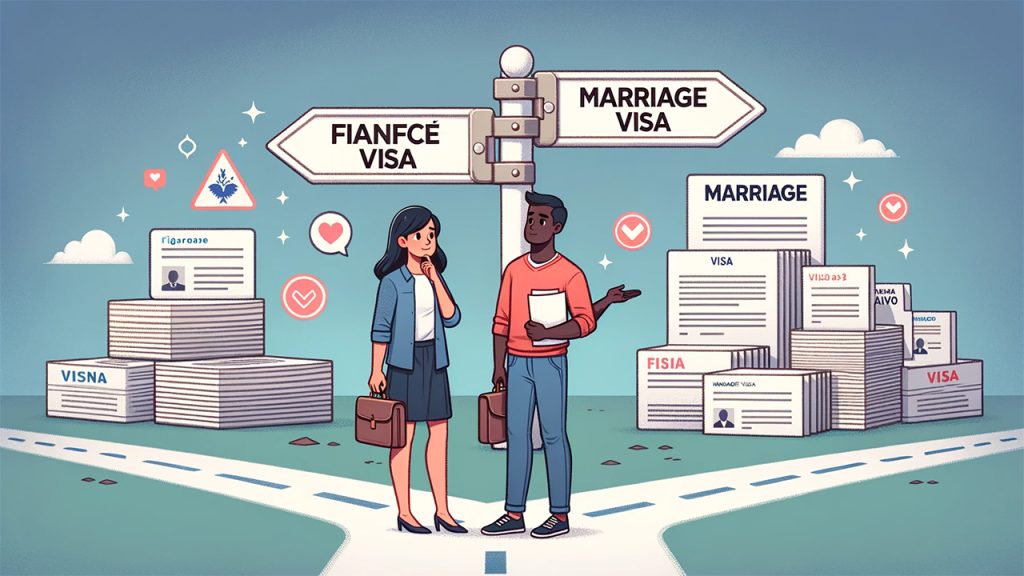
An immigration lawyer can tell you all about the requirements specific to each application as well as go over the benefits or negative features of any particular immigration process. They will be able to give you an idea of when you might be able to travel to the United States based on current processing times and when certain benefits will be available to you such as the ability to work after arriving in the United States.
Whether you are applying for a fiancé visa or marriage visa, you will want to make sure you meet the basic requirements and are prepared for your visa interview. Many people are surprised by how long USCIS is currently taking to process many immigration applications. The best way to prevent delayed processing of your application is to make sure you meet the basic requirement and submit a complete application with the correct supporting documentation. The eligibility requirements and specific evidence required of each application can generally be found on the USCIS website and form instructions for any particular application.