


Getting an H-1B visa can open doors for skilled workers to pursue career opportunities in the United States. This visa is a great option for U.S. employers to hire foreign talent in specialized fields. But, the path to a successful H-1B visa application requires careful planning and a clear understanding of the process outlined by the United States Citizenship and Immigration Services (USCIS).
A well-prepared H-1B visa application shows that you meet all the legal requirements and increases your chances of getting the work visa approved.
In the following sections, we will go through ten important steps to apply for an H-1B visa. Each step is crucial and helps you move closer to getting your H-1B visa and starting your career in the U.S. We will talk about everything from paying the required fees to checking your application thoroughly before sending it in.
Pay All Required Filing Fees for Your H-1B Visa Application
One of the initial steps in the H-1B visa application process is ensuring all necessary filing fees are covered. The United States Citizenship and Immigration Services (USCIS) mandates certain fees that need to be paid to process your application. Here’s a simplified breakdown:

USCIS Filing Fees
- Base Filing Fee: This is the basic fee required for processing your H-1B petition. It covers the cost of processing the Form I-129, the petition for a nonimmigrant worker.
- ACWIA (American Competitiveness and Workforce Improvement Act) Fee: Depending on the size of your employing company, this fee can vary. For instance, employers with 1-25 full-time employees are required to pay a lower ACWIA fee compared to larger companies.
- Certain organizations are exempt from this fee, including institutions of higher education, nonprofit research organizations, governmental research organizations, and primary or secondary educational institutions among others.
- Fraud Prevention and Detection Fee: A standard fee to help USCIS prevent and detect fraud in the H-1B visa application process. This fee is required for new H-1B petitions and transfer applications, but not for extensions of H-1B status with the same employer.
- Public Law 114-113 Fee: An additional fee under Public Law 114-113 is required alongside the Fraud Prevention and Detection fee in certain scenarios. This fee is applicable when:
- A petitioner files an H-1B or L-1 petition initially to grant status to a nonimmigrant.
- A petitioner seeks authorization for a nonimmigrant in such status to change employers.
- Companies with 50 or more employees in the United States, where more than 50% of these employees hold H-1B, L-1A, or L-1B nonimmigrant status.
- Premium Processing Fee (Optional): The Premium Processing Service is an optional feature provided by USCIS that allows for expedited processing of certain visa petitions, including the H-1B visa application.
- By opting for premium processing, USCIS guarantees a processing time of 15 calendar days. If USCIS fails to process the petition within 15 days, the premium processing fee is refunded.
- This service is particularly beneficial for applicants who are on a tight timeline or those who wish to start their employment in the U.S. at the earliest.
Fee Variations
The total amount you’ll need to pay for your H-1B visa petition can change based on factors like the size of your employing company and the nature of the work visa petition. It’s crucial to check the latest fee structure on the USCIS website to ensure accurate payments.
Payment Method
Ensure you follow the correct payment methods as outlined by USCIS. Incorrect payment methods can lead to delays or even rejection of your H-1B visa petition. Here are some key points regarding the payment method:
- Check and Money Order: Typically, fees to USCIS are paid via check or money order, though the specific guidelines and payment methods may vary, so it’s crucial to check the latest instructions on the USCIS website
- Payable to USCIS: During the H-1B Visa process, fees are primarily paid to USCIS for registration, application, and various other charges.
- Separate Payments for Each Form: USCIS mandates that each form must have its own payment instrument, and combined fee payments are not accepted especially when forms like I-539, I-765, or I-824 are filed together with an H-1B or H-1B1 petition (Form I-129).
- Revocation and Re-filing: If a petition is revoked because the beneficiary left the employer before the expiration date of their status, the Fraud Prevention and Detection Fee does not need to be paid again if re-filing for the same beneficiary at a later date unless a “new” initial grant of the same status is being requested.
Important Tips
- Stay Updated: USCIS may change the fee structure. Regularly check their website for the latest updates.
- Proof of Payment: Keep a copy of all payment receipts as proof of payment which can be helpful in case of any discrepancies in your H-1B application process.
By accurately covering all required filing fees and keeping proof of payment, you set a strong foundation for your H-1B visa application process. This attention to detail in adhering to USCIS guidelines is crucial for moving forward successfully with your work visa petition.
Fill Out and Submit All Necessary Forms for Your H-1B Visa Application
Ensuring that all necessary forms are completed accurately and included in your H-1B visa petition is fundamental to a smooth processing experience with the United States Citizenship and Immigration Services (USCIS).

Labor Condition Application (LCA)
- Filing Requirement: Every employer intending to hire a foreign national under an H-1B visa must file a Labor Condition Application (LCA) with the U.S. Department of Labor (DOL).
- Prevailing Wage Determination: Before the DOL certifies the LCA, the employer must obtain a prevailing wage determination to ensure the foreign worker’s salary is on par with others in the same location and field. This can be obtained from:
- The National Prevailing Wage and Center (NPWC).
- An independent, authoritative source conducting a survey.
- Another legitimate source of wage information.
Form ETA-9035
- Electronic Submission: Post the prevailing wage determination, the employer needs to submit the LCA by filing Form ETA-9035 with the DOL via the Foreign Labor Application Gateway (FLAG) system.
- Timing: This form should not be submitted more than six months from the employment start date.
- Special Circumstances: Employers with physical disabilities or without internet access may file their ETA 9035 by mail, but they must send a prior request for special permission to the Office of Foreign Labor Certification (OFLC)
Form I-129 (Petition for Nonimmigrant Worker)
- Submission: Once the LCA is complete, the employer files Form I-129 to officially submit the H-1B petition.
- Employment Details: The form should include an employment letter detailing the position’s duties, employment dates, description, salary offered, position requirements, and contact information.
- Supporting Documents: Accompany the form with supporting documents like the foreign employee’s academic qualifications, training certificates, membership documents, resume, and a letter of support.
Important Tips
- Accuracy is Key: Ensure all the information provided across various forms is consistent and accurate to avoid any discrepancies.
- If a section doesn’t apply, follow the instructions on how to indicate that, instead of leaving it blank.
- Keep Updated Forms: Always use the most recent versions of the forms available on the USCIS website.
- Seek Professional Help: If necessary, consult with a reliable U.S. immigration attorney to ensure all forms are accurately completed and submitted.
By ensuring that all forms are accurately completed and included in your H-1B visa petition, you’re laying a solid foundation for a successful application. This diligent approach showcases your thoroughness to USCIS, making your petition more likely to progress smoothly through the evaluation process.
Ensure Proper Signatures and Completion of H-1B Visa Forms
Getting every signature right and properly executing all forms is a crucial step in your H-1B visa application process. The United States Citizenship and Immigration Services (USCIS) is very particular about the correctness and completeness of all submitted documents. Here’s a more straightforward breakdown of this step:

USCIS Signature Requirements
- Original Signatures: The USCIS necessitates that original signatures be provided on each form involved in the H-1B application process.
- Signature Accuracy: Ensure all required signatures are accurate and in the right places on the H-1B application forms.
- Signature Ink Color: It’s advised to make all signatures on the petition in blue ink to easily identify the original signature. Using black ink can lead to difficulties in distinguishing between the original and the copy, as the copy will be black and white, rendering the signature hard to discern.
Execution of Forms
- Completeness: Fill out all sections of the forms. If a section doesn’t apply to you, follow the USCIS instructions on how to indicate that on the form. Ensuring all questions are answered and that answers are consistent and correct throughout the entire package, including the petition and all accompanying documentation, is crucial. It’s essential to double-check the petition for consistency, as the USCIS cannot make assumptions about what a petitioner intended if it’s not clear on the submitted documents.
- Correct Form Versions: It’s essential to use the most recent versions of each form required for the H-1B visa application. The USCIS periodically updates the forms, and using an outdated form can lead to your application being rejected or delayed.
- Appropriate Service Center: File the H-1B petition at the appropriate USCIS service center based on jurisdiction. The correct filing location can be determined based on the work location of the H-1B beneficiary and other factors. Ensuring that your petition is sent to the correct service center is crucial for timely processing of your application.
By paying close attention to the accuracy of signatures and the correct execution of forms, you’re significantly reducing the chances of facing hurdles during the USCIS review process. This meticulous attention to detail is crucial for moving smoothly through the H-1B visa application process, getting you one step closer to your goal of working in the United States.
Provide a Certified and Executed Labor Condition Application (LCA)
A Labor Condition Application (LCA) is a crucial document in the H-1B visa application process.

LCA ensures that foreign workers are paid at least the prevailing wage and work under fair conditions and hiring a foreign worker won’t adversely affect the wages and working conditions of U.S. workers.
Employers must pay at least the prevailing wage, which is the average wage paid to similarly employed workers in the specific occupation in the area of intended employment.
Obtaining and Executing the LCA
The first step in this process is to obtain a prevailing wage, which must be the higher of the actual wage rate or the prevailing wage for the occupational classification in the area of intended employment.
Employers file the LCA with the Department of Labor (DOL) using Form ETA-9035 or 9035E. This can be done electronically through the FLAG system, with exceptions for employers with physical disabilities or those lacking internet access, who may file by mail with prior special permission.
DOL Review and Certification
Once submitted, the DOL reviews the LCA within seven working days for completeness and obvious errors or inaccuracies. If approved, the LCA is certified, and employers can proceed with the H-1B visa application process.
Compliance and Public Access File
Employers must document compliance with LCA requirements in a public access file and are required to maintain this file for public inspection.
By including a certified and executed LCA in your H-1B visa petition, you’re demonstrating adherence to U.S. labor laws, which is vital for a successful application. This step underscores the legal and ethical obligations involved in hiring foreign workers under the H-1B visa program.
Attach a Support Letter Detailing the Specialty Occupation
Crafting a meticulously detailed support letter is a pivotal step in your H-1B visa application process. This letter serves as a formal document to the United States Citizenship and Immigration Services (USCIS) to substantiate the claim that the job offered is a specialty occupation and that the beneficiary (the visa applicant) is suitably qualified for the position. Here’s a detailed breakdown of how to compose an effective support letter:
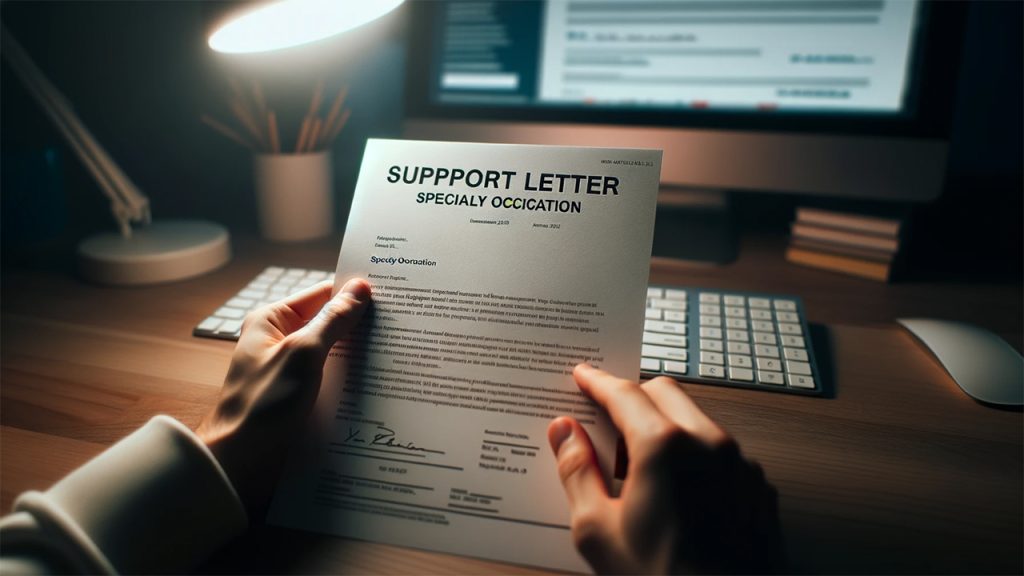
Letter Heading and Introduction
- Employer’s Letterhead: Start with the employer’s letterhead to give the letter a formal and professional appearance.
- Date and Address: Include the date and address it to the USCIS, specifying the processing service center.
- Subject Line: Mention the employer’s and employee’s names and the nature of the petition, for instance, ‘H-1B Visa Application for [Employee’s Name]’.
Employer and Employee Relationship
- Detailed Description: Describe the employer-employee relationship, elucidating the daily control the employer has over the employee’s tasks.
- Resources Provided: Mention the resources like laptops, desktop computers, and other equipment provided by the employer for the employee to perform their job duties.
Job Details
- Job Description: Describe the job being offered, emphasizing why it’s classified as a specialty occupation.
- Specific Job Duties: List the specific job duties, educational requirements, and any particular skills or technologies crucial for the job.
- Job’s Significance: Explain how the job fits within the employer’s business and how the employee’s role is critical to the business operations.
Beneficiary’s Qualifications
- Educational Background: Detail the beneficiary’s education, including degrees, institutions, and any relevant certifications.
- Work Experience: Provide a brief employment history, showing the beneficiary’s progression and achievements in their field.
Closing
- Approval Request: Express confidence in the beneficiary’s qualifications for the position offered and request the USCIS to approve the petition.
- Contact Information: Provide contact information for further inquiries or additional information.
Additional Tips
- Professional Consultation: If needed, consult a U.S. immigration attorney to ensure the support letter is well-crafted and meets the USCIS requirements.
- Revision: Before submission, review the letter for accuracy, completeness, and clarity to ensure it portrays the intended message effectively.
By including a well-structured and detailed support letter in your H-1B visa application, you significantly substantiate the specialty occupation claim, which is a crucial step towards a successful H-1B visa petition. This document, when crafted accurately, not only portrays the professional aura of the employer but also emphasizes the eligibility and qualifications of the beneficiary, thus moving you closer to achieving your goal of working in the United States.
Submit Proof of the H-1B Beneficiary’s Qualifications
Demonstrating the beneficiary’s qualifications for the specialty occupation is a pivotal step in the H-1B visa application process. The United States Citizenship and Immigration Services (USCIS) necessitates substantial evidence to validate the beneficiary’s eligibility for the specialty occupation in question. Here’s a more comprehensive approach to this step:

Collection of Essential Documentation
- Educational Credentials: Acquire copies of all pertinent degrees, certificates, and transcripts related to the specialty occupation. This encompasses your bachelor’s degree or higher, showcasing your eligibility for the H-1B category.
- Professional Certifications: Incorporate any professional certifications that further substantiate your qualification for the position.
- Work Experience: Document any prior work experience pertinent to the specialty occupation. This can encompass letters from previous employers, if applicable, to complement your eligibility for the job.
Verification and Evaluation
- Educational Evaluation: If your education was procured outside the U.S., an educational evaluation may be requisite to equate foreign educational credentials to U.S. standards, aiding the USCIS in determining the U.S. equivalency of your degree.
- License Verification: Should the occupation necessitate licensure, furnish proof of your license to practice in the state of intended employment.
Supplementary Documentation
- Recognition of Educational Qualification: Obtain a letter from the registrar certifying the completion of your education.
- Additional Qualifications: Provide documents that affirm your additional qualifications in the area of employment, for instance, other educational or technical degrees.
Company-Related Documentation
- Company Information: This could comprise documents and information regarding the company, the H-1B holder’s position, and job recruitment like a brochure, job offer letter, and a copy of the contract if applicable.
- Job Description and Terms of Employment: Furnish detailed documents elucidating the terms and conditions of employment alongside a thorough job description.
Response to Request for Evidence (RFE)
In the event USCIS issues a Request for Evidence (RFE) concerning beneficiary qualifications, it’s crucial to respond with the necessary documentation and clarifications as requested.
Ascertain that all the documents for your H-1B work visa petition are accurately represented and verified to avert any discrepancies or issues during the USCIS review process. Common oversights include incomplete documentation and unverified credentials.
By meticulously amassing, verifying, and presenting all requisite documentation, you significantly bolster the chances of a seamless H-1B visa application process. This thorough approach underscores your eligibility and readiness for the H-1B visa, paving the way for a successful application.
Provide Documentation for Cap-Exempt Status or Cap-Subject Lottery Selection
The H-1B visa has an annual cap, which means there’s a limit on how many H-1B visas are issued each year. However, certain employers are cap-exempt, allowing them to petition for H-1B visas without being subject to this cap. This distinction between cap-exempt and cap-subject employers significantly impacts the H-1B visa application procedure.

Understanding Cap-Exempt and Cap-Subject
Cap-Exempt Employers
These employers are not subject to the annual cap imposed on H-1B petitions. The categories of cap-exempt employers include:
- Institutions of higher education or related or affiliated nonprofit entities.
- Nonprofit research organizations.
- Governmental research organizations.
- For-profit companies seeking to hire individuals for specialty occupation services provided to an approved non-profit.
Cap-Subject Lottery
Employers not falling under the cap-exempt category are termed as cap-subject employers. Their H-1B visa petitions enter a lottery system if the number of applications exceeds the annual cap of 65,000 regular H-1B visas and an additional 20,000 for individuals holding advanced degrees at a master’s level or beyond.
It is important to keep up with the latest USCIS guidelines regarding cap-exempt and cap-subject classifications.
Transitioning Between Cap-Exempt and Cap-Subject Employers
Transitioning from a cap-exempt to a cap-subject employer can be a complex process requiring the filing of a cap-subject case during the lottery. This transition can be challenging, especially if the H-1B cap for the year has already been reached. Conversely, concurrent employment is possible, allowing an individual to work for both a cap-exempt and a cap-subject employer without the cap-subject employer having to go through the H-1B lottery process.
Providing Proof
- For Cap-Exempt Employers: Provide documentation proving the cap-exempt status of the employer.
- For Cap-Subject Employers: If selected in the lottery, provide the lottery selection confirmation.
By thoroughly understanding the distinctions between cap-exempt and cap-subject employers and the implications of these classifications on the H-1B visa application process, you are better positioned to navigate the complexities of securing an H-1B visa.
Provide Proof of the H-1B Beneficiary’s Maintenance of Status
If the beneficiary is already in the U.S., it’s imperative to show proof of maintenance of status when applying for an H-1B visa. This step is crucial as it demonstrates adherence to the terms of the current visa classification, which is essential for transitioning to an H-1B visa without having to leave the U.S. Here’s a more detailed approach to this step:

Maintenance of status refers to the adherence of the beneficiary to the terms of their current visa classification. This is vital for a seamless transition to an H-1B visa.
Necessary Documentation
- Current Visa Documentation: Provide copies of the beneficiary’s current visa, I-94 record, and other relevant immigration documents.
- Employment Verification: If applicable, include letters from the current employer verifying the beneficiary’s employment and adherence to visa terms.
Aspects of H-1B Maintenance
- Valid Immigration Documents: It’s crucial to keep the passport valid for at least six months into the future. Additionally, the H-1B status expiration date should always be in the future, as verified by checking the I-94 admissions record or I-797 approval notice.
- Adherence to Regulations: H-1B employees must understand and comply with U.S. federal laws and regulations governing H-1B status. Failure to do so could lead to a violation and loss of immigration status.
Verification and Evaluation
- Educational and Professional Credentials: It may be necessary to provide documentation of the beneficiary’s education and professional credentials, especially if related to maintenance of status.
- Communication with USCIS: Ensure clear communication with the United States Citizenship and Immigration Services (USCIS) regarding the maintenance of status, especially if there are any changes or updates.
Common Mistakes to Avoid
- Outdated or Incomplete Documentation: All documents provided should be up-to-date and complete to prevent any delays or issues with the application.
- Lack of Understanding: A clear understanding of the maintenance of status requirements and adherence to them is crucial to avoid complications.
By meticulously providing proof of the beneficiary’s maintenance of status, applicants can ensure a smoother process in their H-1B visa application, demonstrating their adherence to U.S. immigration laws and regulations. This step is vital in advancing towards a successful H-1B visa application and continuing the journey towards working and residing in the U.S.
Mail the H-1B Visa Petition to the Designated USCIS Service Center
Ensuring that your H-1B visa petition reaches the correct United States Citizenship and Immigration Services (USCIS) service center is a crucial step towards a successful application. The right service center for your petition depends on various factors including the geographic location of your employment and the location of your company’s primary office. Here’s a more detailed guide to help you navigate this step:

Determining the Correct USCIS Service Center
Location-Based Determination
Your company or organization’s primary office location plays a pivotal role in determining the correct service center for mailing your H-1B visa petition.
For example, if your company’s primary office is in Massachusetts, you would direct your petition to the Vermont Service Center (VSC), regardless of where you (the beneficiary) will be working.
Specific USCIS Service Centers
The USCIS has designated service centers for handling H-1B visa petitions, namely the California Service Center (CSC), the Vermont Service Center (VSC), the Nebraska Service Center (NSC), or the Texas Service Center (TSC) depending on the specifics of your petition and your location.
Mailing the Petition
Use Reliable Mail Services
Employ reliable mail services like FedEx to ensure your petition reaches the USCIS service center safely and in a timely manner. Utilize tracking services to confirm the delivery of your H-1B petition.
Addresses
Ensure you have the correct address for the service center handling your work visa petition. For instance, if mailing to the California Service Center, the address is:
U.S. Citizenship and Immigration Services
California Service Center
ATTN: Cap Exempt H-1B Processing Unit
P.O. Box 30040
Laguna Niguel, CA 92607-3004.
Common Mistakes to Avoid:
- Wrong Service Center: Mailing your petition to the incorrect service center can result in significant delays.
- Late Mailing: Mail your petition well ahead of any deadlines to account for any unforeseen delays in mail delivery.
As always. maintain copies of all documents you mail for your records, as well as for reference in any future correspondence with USCIS.
By meticulously adhering to the guidelines on where to mail your H-1B visa petition, you can prevent unnecessary delays, ensuring a smoother processing of your application. Following these instructions meticulously will contribute significantly towards making your H-1B visa application process seamless and successful.
Review Your H-1B Visa Petition
Before mailing your H-1B visa petition to the United States Citizenship and Immigration Services (USCIS), a thorough review is indispensable. This step ensures that all details are accurate and complete, significantly reducing the likelihood of delays or denials. Here’s a simplified guide to this step:
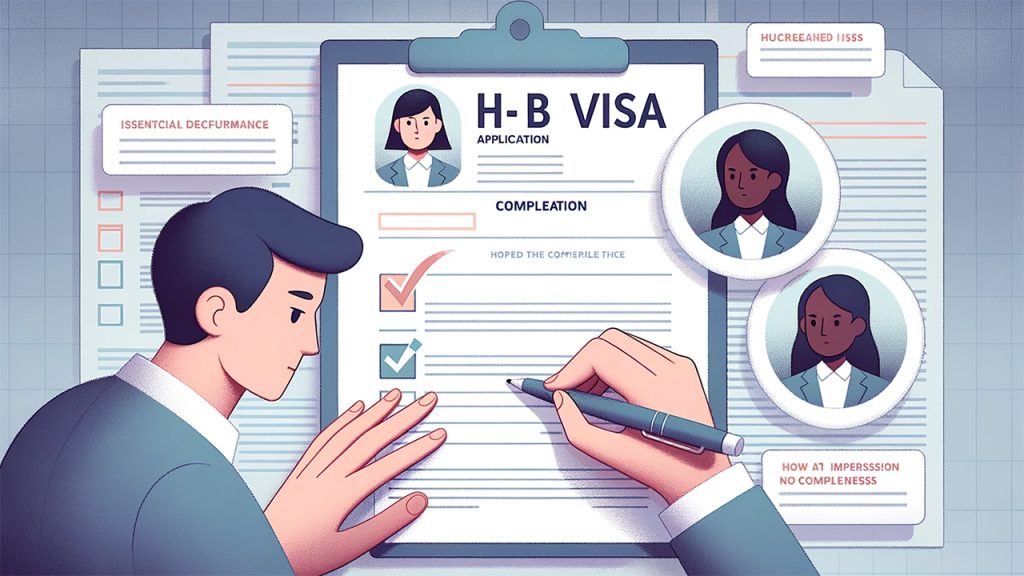
Self-Review Checklist
Completeness
- Every section of each form should be filled out. If a section does not apply, it’s important to follow the USCIS guidelines on how to indicate that, rather than leaving it blank.
- Check that all required supporting documentation is included, such as educational credentials, work experience letters, and a certified Labor Condition Application (LCA).
Consistency
- Ensure that the information provided is consistent across all forms and documents. For instance, the job title and employer name should be identical wherever mentioned.
- Dates, names, and other personal details should match exactly across all forms and supporting documents.
Signature and Date
- Verify that all required sections are signed and dated correctly.
- Ensure that signatures are original where required, and follow USCIS guidelines for electronic signatures if applicable.
Professional Review
- It’s highly advisable to have your petition reviewed by a U.S. immigration attorney who is familiar with the H-1B visa process.
- They can identify any potential issues that might arise and suggest how to address them before submission.
Common Mistakes to Avoid
- Overlooking Small Details: Even minor mistakes like misspellings or incorrect dates can cause significant delays in processing or even denial of your petition.
- Ignoring Professional Advice: If adjustments are suggested during a professional review, it’s crucial to understand and implement the suggested changes.
Additional Tips
- Double-Check: Reviewing your petition multiple times, and having another trusted individual or a professional review it as well, can help catch any errors or inconsistencies.
- Document Organization: Organize your documents in a clear, logical manner, following any specific instructions provided by USCIS for document order and separation.
- Consider creating a cover letter or a contents page to help USCIS officers easily navigate through your petition.
The review process is your final opportunity to catch and correct any errors before your H-1B visa petition is in the hands of USCIS. A thorough review, whether done personally or with the help of a professional, is a worthwhile investment towards ensuring a successful H-1B visa application.
Additional Steps and Considerations for Your H-1B Visa Application
Beyond the core steps outlined, there are additional considerations and steps that could be relevant depending on individual circumstances for your H-1B visa application. Here’s a simplified guide to some of these additional aspects:

Identifying a Sponsor
- The H-1B visa is employer-sponsored, meaning an eligible U.S. employer must file the H-1B petition on the beneficiary’s behalf.
- It’s crucial to secure a sponsorship from an employer who has a genuine job offer and is willing to go through the H-1B visa application process.
Obtaining a Prevailing Wage Determination
- The prevailing wage is the average wage paid to similarly employed workers in the specific occupation in the area of intended employment.
- The employer must obtain a prevailing wage determination from the Department of Labor (DOL) using the prevailing wage portal or by requesting a National Prevailing Wage Center (NPWC) determination.
- It’s vital that the wage offered to the H-1B visa applicant meets or exceeds the prevailing wage to ensure compliance with labor laws.
Digital Photograph
- USCIS has specific requirements for the digital photograph that must be included in the H-1B visa application.
- The photograph should be in color, have a plain white or off-white background, and meet the size and resolution specifications outlined by USCIS.
Consular Processing
- If the beneficiary is outside the U.S., consular processing is required. This involves attending a visa interview at a U.S. embassy or consulate.
- The beneficiary should prepare for the interview by gathering all necessary documentation, including the approved H-1B petition, job offer letter, and any other required documents.
Common Mistakes to Avoid
- Lack of Preparation: It’s vital to have all documentation prepared and reviewed for accuracy well in advance of filing the H-1B petition.
- Ignoring USCIS Updates: USCIS often updates its policies and procedures. Staying updated on these changes is crucial to ensure compliance and avoid unexpected issues.
Additional Tips
- Stay Informed: Regularly check the USCIS website and other reputable sources for updates on H-1B visa policies and procedures.
- Consult a U.S. Immigration Attorney: An immigration attorney can provide valuable insights and guidance, ensuring the H-1B visa application process goes smoothly.
Each of these additional steps and considerations plays a crucial role in the H-1B visa application process. Being well-informed and meticulously prepared can significantly enhance the likelihood of a successful H-1B visa application.
The Path to H-1B Visa Success: Wrapping Up
The H-1B visa application process requires a blend of meticulous preparation, adherence to United States Citizenship and Immigration Services (USCIS) guidelines, and a thorough understanding of the process. The 10 essential steps outlined in this guide aim to provide a structured pathway towards a successful H-1B visa application. By following each step meticulously, from covering all required filing fees to reviewing your petition thoroughly before submission, you’re significantly enhancing the likelihood of a smooth and favorable process with the USCIS.

Furthermore, considering the complex nature of immigration laws and USCIS policies, consulting with a seasoned U.S. immigration attorney is a prudent step to ensure that all aspects of your application are in compliance with the prevailing regulations.
As you navigate this pivotal pathway to working and building a fulfilling career in the U.S., the adherence to each of these steps, coupled with professional guidance, can substantially mitigate potential hurdles, making your H-1B visa application process less daunting and more achievable. With a well-prepared and compliant H-1B visa petition, you are not just fulfilling a procedural requirement, but taking a significant stride towards realizing your professional aspirations in the United States.